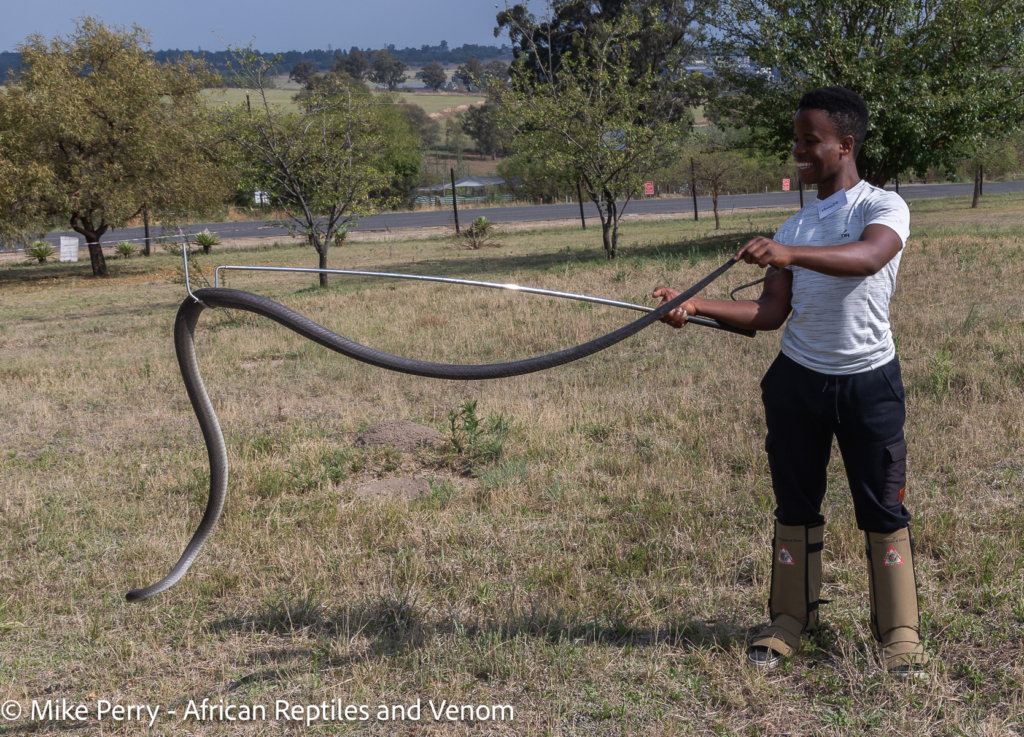
Dangerous Snakes of the Eastern Cape
The Medically Significant Snakes of the Eastern Cape Province: A Factual Guide
The Western Cape has a unique mix of arid, coastal, and mountainous habitats, hosting several highly dangerous venomous snakes, including species endemic to the region. The province is home to five species considered Highly Venomous (has caused human fatalities).
SCROLL INDEX
Highly Venomous Species (Potentially Life-Threatening Bites)
Regional and Rare Dangerous Species
Highly Venomous/Life Threatening Species
Dangerous/Medically Significant Species
Highly Venomous Species (Potentially Life-Threatening Bites)
These species have venom that can result in human fatality without quick medical intervention and usually require antivenom.
Black Mamba – © Mike Perry
DANGEROUS SNAKES OF THE EASTERN CAPE PROVINCE
Black Mamba (Dendroaspis polylepis)
- Eastern Cape Distribution: Found primarily in the drier, northern parts of the province (from around Port St Johns northwards), and usually restricted to warmer bushveld and savannah areas.
- Danger Level: Highly Venomous (Very Dangerous – has caused many human fatalities).
- Venom Type: Potent Neurotoxic venom.
- Description: A large, feared snake known for its speed and narrow, “coffin-shaped” head. It is one of Africa’s deadliest snakes.
Eastern Green Mamba © Caity Sarkozi
DANGEROUS SNAKES OF THE EASTERN CAPE PROVINCE
Eastern Green Mamba (Dendroaspis angusticeps)
- Eastern Cape Distribution: Strictly confined to the humid coastal forests of the far north-eastern parts of the province.
- Danger Level: Highly Venomous (Very Dangerous – has caused human fatalities).
- Venom Type: Potent Neurotoxic venom.
- Description: A slender, bright green, highly arboreal snake. It is mostly shy and less defensive than the Black Mamba.
Cape Cobra © Alex Rebelo, some rights reserved (CC BY NC)
DANGEROUS SNAKES OF THE EASTERN CAPE PROVINCE
Cape Cobra (Naja nivea)
- Eastern Cape Distribution: Common and widespread over most of the Eastern Cape but NOT found in the north-east area, ie: the old Transkei (ie: generally not found East of Stutterheim and north of East London). It can be found in any habitat.
- Danger Level: Highly Venomous (Very Dangerous – has caused many human fatalities).
- Venom Type: Potent Neurotoxic venom.
- Description: A highly variable snake in colour (yellow, brown, speckled, or black) that is quick to rear and spread a broad hood when disturbed.
Rinkhals © Kevin Ulett, some rights reserved (CC BY NC)
DANGEROUS SNAKES OF THE EASTERN CAPE PROVINCE
Rinkhals (Hemachatus haemachatus)
- Eastern Cape Distribution: Widespread across the high-lying grasslands and fynbos areas of the Eastern Cape.
- Danger Level: Highly Venomous (Dangerous – has caused human fatalities).
- Venom Type: Mixed Cytotoxic and Neurotoxic venom, which it can spit accurately.
- Description: A medium-sized snake related to cobras that can spread a hood. It is known for its habit of pretending to be dead (shamming or feigning death). Can be all black or grey but in the Eastern Cape Rinkhals are mostly black with yellow/cream rings.
Puff Adder © Kevin Ulett, some rights reserved (CC BY NC)
DANGEROUS SNAKES OF THE EASTERN CAPE PROVINCE
Puff Adder (Bitis arietans)
- Eastern Cape Distribution: Widespread across almost all habitat types within the province, excluding very high mountains.
- Danger Level: Highly Venomous (Very Dangerous – has caused human fatalities).
- Venom Type: Potently Cytotoxic venom.
- Description: The heavy-bodied viper, exceptionally camouflaged and slow-moving. It is responsible for large number of serious bites due to its habit of lying still on footpaths.
Boomslang – © Jean Hirons, some rights reserved (CC-BY-NC)
DANGEROUS SNAKES OF THE EASTERN CAPE PROVINCE
Boomslang (Dispholidus typus)
- Eastern Cape Distribution: Widespread in areas with sufficient tree or bush cover, including coastal forests and thicket.
- Danger Level: Highly Venomous (Very Dangerous – has caused human fatalities).
- Venom Type: Potently Haemotoxic venom.
- Description: A large-eyed, slender, and shy arboreal snake. Bites are rare due to its reluctant nature and rear-fanged dentition. Females are generally brown in color and males from the Eastern Cape are mostly black and yellow, or black and greenish-tellow.
Southern Twig Snake © Graham G, some rights reserved (CC BY NC)
DANGEROUS SNAKES OF THE EASTERN CAPE PROVINCE
Southern Twig Snake (Thelotornis capensis)
- Eastern Cape Distribution: Primarily found in the coastal thicket and forest patches in the far north-eastern parts of the province.
- Danger Level: Highly Venomous (Very Dangerous – has caused human fatalities).
- Venom Type: Haemotoxic venom.
- Description: A thin, cryptic tree snake with excellent camouflage, resembling a twig.
Regional and Rare Dangerous Species
These snakes have a Dangerous bite, but do not cause death and no antivenom is required.
Cape Coral Snake © Kevin Ulett, some rights reserved (CC BY NC)
DANGEROUS SNAKES OF THE EASTERN CAPE PROVINCE
Cape Coral Snake (Aspidelaps lubricus)
- Eastern Cape Distribution: Occurs in the drier, western interior and Karoo regions of the province.
- Danger Level: Venomous (Bites are rare, but venom is potent; antivenom is not available).
- Venom Type: Predominantly Neurotoxic venom.
- Description: A small, secretive snake with striking black and red/yellow bands, capable of raising a small hood when threatened.
Rhombic Night Adder © Craig Peter, some rights reserved (CC BY NC)
DANGEROUS SNAKES OF THE EASTERN CAPE PROVINCE
Rhombic Night Adder (Causus rhombeatus)
- Eastern Cape Distribution: Widespread and common throughout the province, particularly in gardens and grassland areas.
- Danger Level: Venomous (Bites are common and cause moderate to severe local swelling and pain).
- Venom Type: Mildly Cytotoxic venom.
- Description: A common snake with distinctive dark rhombic or diamond-shaped marking down its back and a “V” marking on its head. It is active both day and night.
Berg Adder from near Cape St Francis, Eastern Cape © Kevin Ulett, some rights reserved (CC BY NC)
DANGEROUS SNAKES OF THE EASTERN CAPE PROVINCE
Berg Adder (Bitis atropos)
- Eastern Cape Distribution: From the coast to high-altitude mountainous areas and rocky slopes, particularly in the western and central regions.
- Danger Level: Venomous (Venom often causes severe pain and non-fatal systemic effects, including blindness).
- Venom Type: Predominantly Cytotoxic venom, with possible neurotoxic effects.
- Description: A small, slow-moving adder with a triangular head, typically grey-brown with indistinct darker markings. It often relies on camouflage rather than fleeing.
Horned Adder © Rika du Plessis, some rights reserved (CC BY NC)
DANGEROUS SNAKES OF THE EASTERN CAPE PROVINCE
Horned Adder (Bitis caudalis)
- Eastern Cape Distribution: Restricted to the extremely arid, sandy, and desert-like regions in the western Karoo parts of the province.
- Danger Level: Venomous (Venom can cause moderate to severe local swelling and pain).
- Venom Type: Predominantly Cytotoxic venom.
- Description: A small, attractively patterned adder distinguished by a prominent, erect horn-like scale above each eye. It may be found buried in sand.
Plain Mountain Adder © saindigenous, some rights reserved (CC BY NC)
DANGEROUS SNAKES OF THE EASTERN CAPE PROVINCE
Plain Mountain Adder (Bitis inornata)
- Eastern Cape Distribution: Endemic to the mountainous grasslands of the Eastern Cape, usually found above 1,500 meters above sea level.
- Danger Level: Venomous (Venom may cause local effects).
- Venom Type: Cytotoxic venom.
- Description: A small, drab-coloured adder lacking strong patterns, found exclusively at high altitudes. It is rarely encountered by humans.
Albany Adder © buggsbalmer, some rights reserved (CC BY NC)
DANGEROUS SNAKES OF THE EASTERN CAPE PROVINCE
Albany Adder (Bitis albanica)
- Eastern Cape Distribution: Endemic and restricted to a tiny area of coastal thicket and fynbos near the city of Port Elizabeth (Gqeberha).
- Danger Level: Venomous (Venom may cause severe local effects, but very little is known).
- Venom Type: Presumably Cytotoxic venom.
- Description: A very small, rare adder with bold markings/transverse bars. It is one of the world’s rarest snakes and is seldom seen.
Red Adder © Matthew Sephton, some rights reserved (CC BY NC)
DANGEROUS SNAKES OF THE EASTERN CAPE PROVINCE
Red Adder (Bitis rubida)
- Eastern Cape Distribution: Endemic to the arid, rocky areas of the Succulent Karoo biome in the western part of the Eastern Cape.
- Danger Level: Venomous (Venom may cause severe pain and local tissue damage).
- Venom Type: Cytotoxic venom.
- Description: A relatively small adder with a red to reddish-brown ground colour and dark blotches. It is largely restricted to rocky habitats.
Images used in this article are copyrighted and belong to Mike Perry, or labeled and obtained with permission from their respective owners,
or licensed under a Creative Commons Attribution-NonCommercial 4.0 International License (CC BY-NC 4.0).
We extend our sincere thanks to the respective photographers who generously
shared their work on iNaturalist, making the visual content of this article possible.
Safety and Medical Protocol
In the event of a snakebite, immediate hospitalization is mandatory. Treatment involves managing symptoms, pain control, and the administration of species-specific antivenom where applicable (available for Mambas, Puff Adders, and Cobras). Never attempt to use methods such as tourniquets, cutting the wound, or sucking out venom. The safest approach to coexistence is to maintain distance and allow all snakes to move away naturally.