Dangerous Snakes of the Northern Cape
The Medically Significant Snakes of the Northern Cape Province: A Factual Guide
The Northern Cape is South Africa's largest and most arid province, dominated by the Karoo, the Kalahari, and the Namaqualand desert regions. This environment supports a unique suite of venomous species, many adapted to burrowing or living in dry, rocky areas. The lack of infrastructure in vast rural areas means that a prompt response to snakebite can be challenging, making public awareness particularly crucial.
SCROLL INDEX
Highly Venomous Species (Potentially Life-Threatening Bites)
Regional and Rare Dangerous Species
Highly Venomous/Life Threatening Species
Dangerous/Medically Significant Species
Highly Venomous Species (Potentially Life-Threatening Bites)
These species have venom that can result in human fatality without quick medical intervention and usually require antivenom.
DANGEROUS SNAKES OF THE NORTHERN CAPE PROVINCE
Black Mamba (Dendroaspis polylepis)
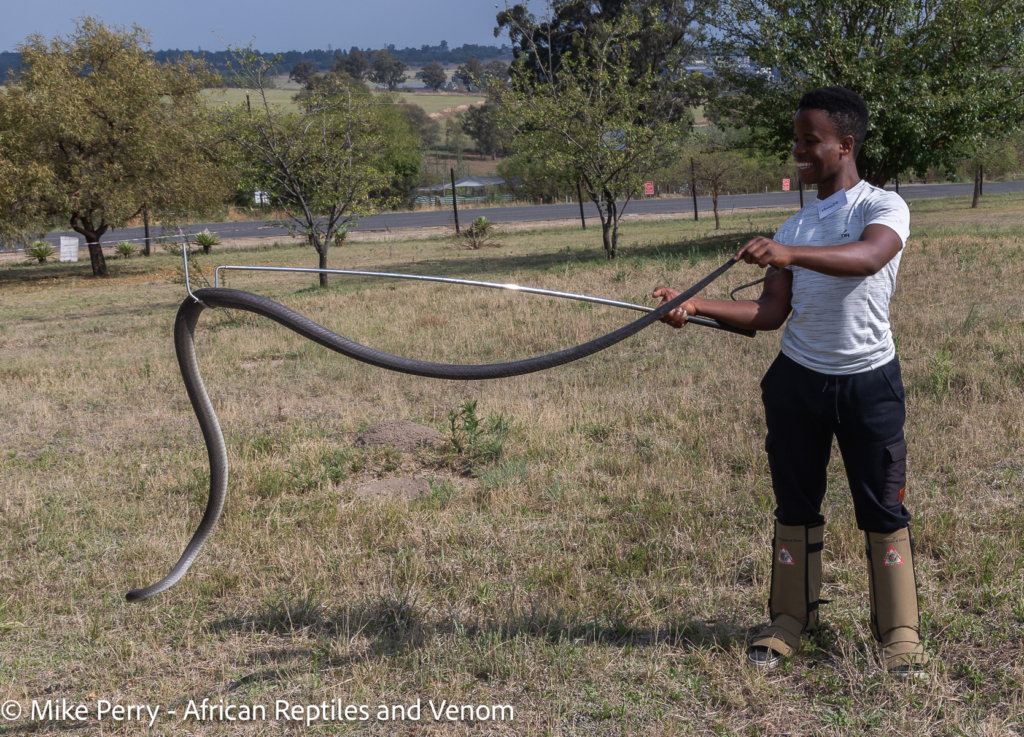
The Black Mamba (Dendroaspis polylepis) has been recorded in the Northern Cape only in the northern Kalahari regions in near the Botswana border. This is Africa’s longest venomous snake, with large adults known to exceed 4 meters. Despite its name, its colour is a shade of olive, dark brown, or grey, with the “black” referring to the interior of its mouth. This mostly terrestrial snake is found across various habitats ranging from riverine and coastal forests, savannas, thonveld, bushveld, and extending into arid areas. The Black Mamba possesses extremely potent and fast-acting neurotoxic venom, which rapidly causes progressive paralysis and subsequent respiratory failure, necessitating immediate and urgent medical treatment.
DANGEROUS SNAKES OF THE NORTHERN CAPE PROVINCE
Cape Cobra (Naja nivea)
Common and widespread in the Northern Cape province. This is the most dangerous cobra in the province, and is highly active during the day. Its colour is extremely variable, ranging from bright yellow or reddish-brown to a solid dark brown or black. It it can be found in almost and habitat including arid rocky areas, karroid veld, dry savannas, grasslands, and fynbos. Its venom is primarily Neurotoxic, which rapidly causes progressive paralysis and respiratory failure. Its diurnal nature and habit of seeking shelter in homes contribute to its status as a major cause of snakebite fatalities in the region.
DANGEROUS SNAKES OF THE NORTHERN CAPE PROVINCE
Black Spitting Cobra (Naja nigricincta woodi)
A subspecies of spitting cobra restricted to the arid western parts of the Northern Cape and southern Namibia. This adult snake is solid matte black, distinct from its barred northern relatives. It is active during the day and is a fast-moving, nervous snake. Its venom is powerfully Cytotoxic, causing severe localized pain, swelling, and tissue necrosis. It can also accurately spit its venom up to 3 meters, aiming for the eyes, which requires immediate thorough rinsing, and medical attention to prevent permanent damage.
DANGEROUS SNAKES OF THE NORTHERN CAPE PROVINCE
Puff Adder (Bitis arietans)
A large, heavy-bodied viper, easily recognized by its distinctive chevron-like pattern. It can be found over most of the Northern Cape. It is sedentary by nature and will often lie in ambush position awaiting food to come within striking range. It is often overlooked due to its camouflaged color-pattern. Its venom is Cytotoxic, causing massive swelling, intense pain, and tissue destruction, which can necessitate skin grafts or even amputation if untreated.
DANGEROUS SNAKES OF THE NORTHERN CAPE PROVINCE
Boomslang (Dispholidus typus)
A slender, large-eyed arboreal snake. I can be found in the north-eastern Kalahari regions of the Northern Cape province in the Van Zylsrus, Hotazel and Kuruman areas. Males are often bright green while females are brownish-grey. It is found in trees, shrubs, and bushes, particularly along river systems. Its venom is highly potent and Haemotoxic (blood-affecting), disrupting the blood-clotting mechanism and causing widespread internal and external bleeding. Though bites are rare due to its shy, rear-fanged nature, a specific monovalent antivenom is required.
Regional and Rare Dangerous Species
These snakes are significant either due to their unique regional distribution, their conservation status, or their unique threat profile. Their bites still require urgent medical assessment.
DANGEROUS SNAKES OF THE NORTHERN CAPE PROVINCE
Cape Coral Snake (Aspidelaps lubricus)
The Cape Coral Snake is a stunning, small elapid found throughout the Namaqualand region of the Northern Cape. This nocturnal, semi-burrowing snake is recognizable by its bright coral-red/orange colouration and distinctive black bands. When threatened, it can flatten its neck to form a small hood. Its venom is primarily neurotoxic, causing potentially dangerous effects on the nervous system, and requires urgent medical care despite the lack of a specific antivenom.
DANGEROUS SNAKES OF THE NORTHERN CAPE PROVINCE
Speckled Shield-nose Snake (Aspidelaps scutatus)
The Speckled Shield-nose snake can be found in the north-eastern Kalahari regions of the Northern Cape province. A smallish thickset nocturnal snake (avg. 45 cm) identified by a large, shovel-like rostral scale used for burrowing. If threatened, it will lift its head like a cobra. Its venom is a combination of Neurotoxic and Cytotoxic components. While bites are rare, they are highly serious, with effects that can include local tissue damage and potential respiratory failure. No antivenom is available.
DANGEROUS SNAKES OF THE NORTHERN CAPE PROVINCE
Bibron's Stiletto Snake (Atractaspis bibronii)
A small, secretive, dark brown or black fossorial (burrowing) snake, known from the north-eastern Kalahari regions of the Northern Cape especially north of Kathu with a record as far south as Groblershoop. Its venom is Cytotoxic, causing extreme localized pain, blistering, and severe tissue damage (necrosis). Its unique, sideways-stabbing fang delivery means it can bite even when held behind the head. No antivenom is available for this species, and bites must be treated symptomatically.
Desert Mountain Adder © Craig Van Rensburg
DANGEROUS SNAKES OF THE NORTHERN CAPE PROVINCE
Desert Mountain Adder (Bitis xeropaga)
A rare, smaller adder (avg. 40 cm) with a highly restricted distribution along the arid mountain slopes and rocky hillsides of the lower Orange River Valley (Richtersveld area). Its coloration is typically ash-grey or orange/brown with darker blotches. Its venom is a combination of Neurotoxic and Cytotoxic properties. Bites can cause severe local effects and sometimes affect breathing. No antivenom is available, and victims are treated symptomatically.
Many Horned Adder © Hennie de Klerk
DANGEROUS SNAKES OF THE NORTHERN CAPE PROVINCE
Many-horned Adder (Bitis cornuta)
A dwarf adder found in the Namaqualand region from the Northern Cape coast inland into rocky and sandy areas. It has been found as far east as Loeriesfontein. It is easily identified by a cluster of two to five raised horn-like scales above each eye. Its venom is Cytotoxic, causing pain and swelling, and occasionally necrosis. It is a slow-moving, cryptic species that relies on camouflage, and its bite is not considered life-threatening.
Horned Adder © Vincent Rufray
DANGEROUS SNAKES OF THE NORTHERN CAPE PROVINCE
Horned Adder (Bitis caudalis)
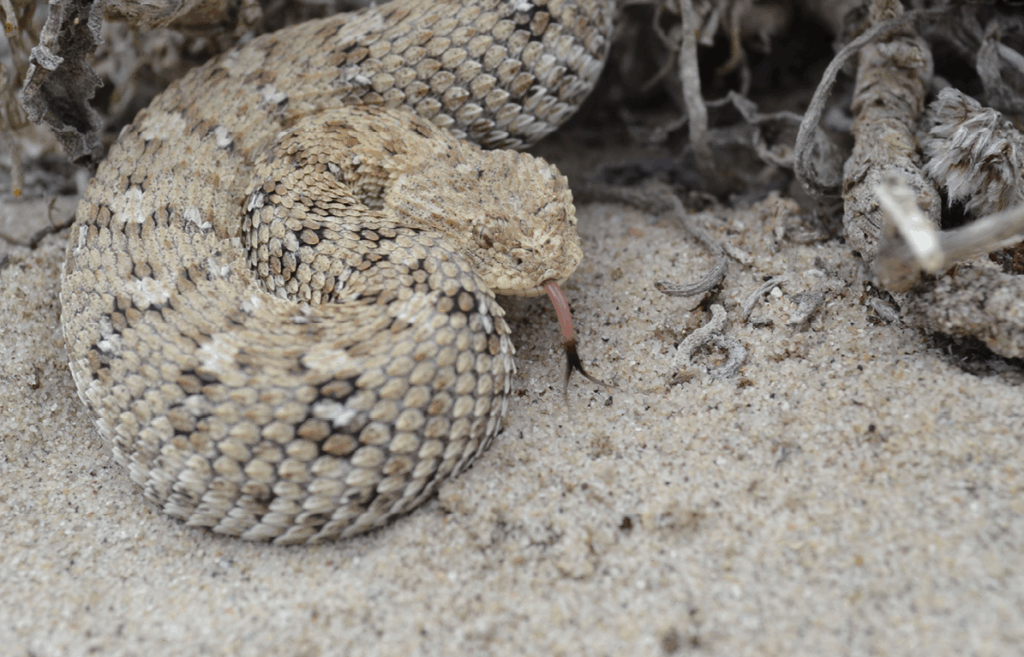
A small, widespread adder easily recognized by a single, prominent horn-like scale above each eye (though this can be reduced or absent). It is common and widespread in the dry, sandy, and arid regions of the Northern Cape, including the Karoo and Kalahari. It often buries itself in loose sand. Its venom is Cytotoxic, causing pain and swelling, but is not life-threatening.
DANGEROUS SNAKES OF THE NORTHERN CAPE PROVINCE
Namaqua Dwarf Adder (Bitis schneideri)
Known as the smallest adder in the world (avg. 20 cm). It is restricted to the vegetated coastal sand dunes in the extreme north-western corner of the Northern Cape (Namaqualand). It possesses a small black-tipped tail, which it uses for caudal luring. Its venom is mildly Cytotoxic, causing only minor pain and swelling, often compared to a bee sting.
Images used in this article are copyrighted and belong to Mike Perry, or labeled and obtained with permission from their respective owners,
or licensed under a Creative Commons Attribution-NonCommercial 4.0 International License (CC BY-NC 4.0).
We extend our sincere thanks to the respective photographers who generously
shared their work on iNaturalist, making the visual content of this article possible.
Safety and Medical Protocol
In the event of a snakebite, immediate hospitalization is mandatory. Treatment involves managing symptoms, pain control, and the administration of species-specific antivenom where applicable (available for Mambas, Puff Adders, and Cobras). Never attempt to use methods such as tourniquets, cutting the wound, or sucking out venom. The safest approach to coexistence is to maintain distance and allow all snakes to move away naturally.